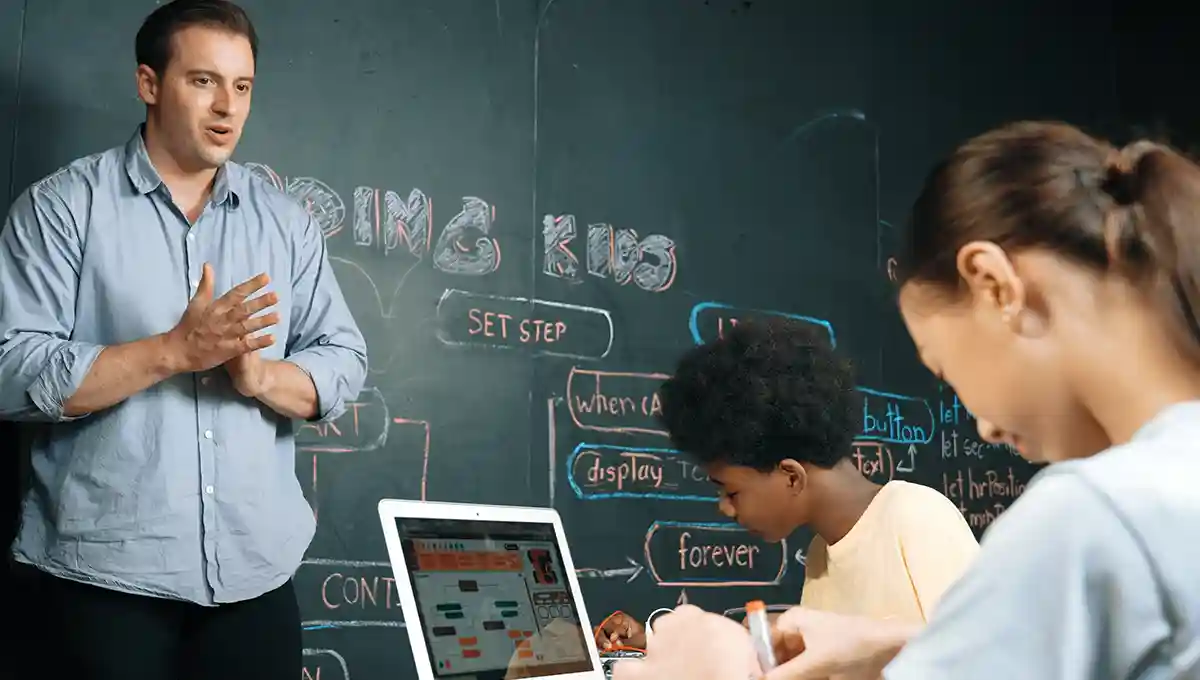
Effective Teaching Strategies That Improve Student Learning Fast
Every teacher knows the "Glazed Eye" look. You’ve prepared a masterpiece of a lesson, your explanation is crystal clear, yet you’re met with a room full of blank stares.
The hard truth? The issue usually isn't the content; it’s the conduit. In an era of shrinking attention spans and diverse learning needs, relying on "broadcast-style" lecturing isn't just old-fashioned, it's ineffective. To bridge the gap between hearing and understanding, we need strategies that turn passive listeners into active participants.
What is Effective Teaching?
Effective teaching isn’t measured by how well a teacher explains; it’s measured by how well a student applies.
As John Dewey famously suggested, true learning is rooted in experience. If a student can’t use the knowledge outside your four walls, the lesson hasn't landed. In 2026, the benchmark for success has shifted from academic memorization to functional literacy and real-world problem-solving.
The Impact Trifecta
To achieve this, three core elements must work in perfect harmony:
- Clear Communication and Retention: If the signal is fuzzy, the recording will be too.
- Safe Environment and Participation: Emotional safety is the prerequisite for curiosity. Students must feel safe enough to be wrong.
- Predictable Structure and Focus: Great classroom management isn't about "control"; it’s about creating a rhythm where learning can happen without interruption.
Traditional vs. Personalized The Great Shift
The "one-size-fits-all" model is moving to the museum. Here’s how the landscape is changing:
|
Feature |
Traditional Teaching |
Personalized Learning |
|
Pace |
Fixed (Keep up or get left behind) |
Adaptive (Mastery-based) |
|
Role of Student |
Passive Recipient |
Active Navigator |
|
Primary Goal |
Content Coverage |
Skill Mastery |
|
Feedback |
Delayed (Tests/Grades) |
Instant (Real-time adjustments) |
Platforms like Khan Academy have shown how adaptive learning improves long-term performance.
4 Steps to a High-Impact Lesson Flow
Stop lecturing and start facilitating. Use this four-step framework to transform your next unit:
Step 1: Establish the "Why" (Clarity)
Don't start with the what. Start with what the students will be able to do by the end of the hour.
Step 2: Spark the Friction (Curiosity)
Ask a provocative question or present a "broken" scenario. Let them struggle with the "why" before you give them the "how."
Step 3: The "Do" Phase (Application)
This is where the magic happens. Whether it's a lab, a debate, or a digital simulation, students must get their hands dirty.
Step 4: The Feedback Loop (Reflection)
End with a 5-minute "Rose, Thorn, and Bud" session: What worked? What was confusing? What are we excited to learn next?
Why "Problem Solving" is the New Currency
Influenced by Lev Vygotsky’s theories on social interaction, modern education focuses on the Zone of Proximal Development, the sweet spot where a student is challenged but supported.
When we prioritize problem-solving over rote memorization, we produce students who:
- Think independently rather than waiting for instructions.
- View mistakes as data points, not failures.
- Can navigate the complexities of a tech-driven world.
Pro-Tip: If you find yourself talking for more than 10 minutes straight, stop. Ask a student to summarize what you just said to a partner. This "micro-break" resets the attention clock.
The Teacher’s "Reality Check"
Before you plan your next lesson, run through this mental checklist:
- Did I check for understanding at least three times?
- Is there a path for the student who finishes in 10 minutes AND the one who needs 40?
- Have I created a space where a "stupid question" is welcomed as a learning opportunity?
The Bottom Line
Teaching is not a data transfer; it’s a human connection. The best educators aren’t those with the loudest voices, but those who build the sturdiest bridges.
By shifting your focus from delivering content to designing experiences, you don't just teach better, you create a classroom that students actually want to be in. Start small, iterate often, and remember: the goal isn’t a perfect lesson; it’s a transformed learner.
What is one strategy you've tried that turned a "blank stare" into a "lightbulb moment"?
FAQ’s
-
What is the most effective strategy in teaching?
The most effective strategy is active learning, where students participate, solve problems, and engage with content instead of passively listening to lectures. - What are the 10 effective teaching strategies?
Ten effective strategies include active learning, clear communication, personalized learning, classroom management, feedback, collaboration, inquiry-based learning, assessment, differentiation, and positive learning environment.
- What are the 7 effective teaching strategies for the classroom?
Seven strategies are communication skills, structured lessons, student engagement, personalized learning, problem-solving activities, feedback loops, and strong classroom management techniques.
- What are the 5 teaching strategies in the classroom?
Five key strategies include direct instruction, cooperative learning, inquiry-based learning, differentiated instruction, and consistent classroom management for better student outcomes.